

(Fig. 11)
Comparison of the results of the adiabatic model (curves 5 & 3) with the experimental data of Venus (curves 1 & 2) and Earth (curve 4). Source: Sorokhtin et al (2007)
I recently came across this paper
(4) Global warming and carbon dioxide through sciences
from Paul Christodoulides and Georgios Florides. I was surprised that I had not seen it before. It is indeed very comprehensive and gives references to the results of quite a number of other relevant papers. If you have the time and if you love climate science, you should go through it. Here I just show a few quotes on the results of their investigation:
ABSTRACT:
Increased atmospheric CO2-concentration is widely being considered as the main driving factor that causes the phenomenon of global warming. This paper attempts to shed more light on the role of atmospheric CO2 in relation to temperature-increase and, more generally, in relation to Earth’s life through the geological aeons, based on a review-assessment of existing related studies. It is pointed out that there has been a debate on the accuracy of temperature reconstructions as well as on the exact impact that CO2 has on global warming. Moreover, using three independent sets of data (collected from ice-cores and chemistry) we perform a specific regression analysis which concludes that forecasts about the correlation between CO2 concentration and temperature rely heavily on the choice of data used, and one cannot be positive that indeed such a correlation exists (for chemistry data) or even, if existing (for ice-cores data), whether it leads to a “severe” or a “gentle” global warming. A very recent development on the greenhouse phenomenon is a validated adiabatic model, based on laws of physics, forecasting a maximum temperature-increase of 0.01 to 0.03 °C for a value doubling the present concentration of atmospheric CO2. Through a further review of related studies and facts from disciplines like biology and geology, where CO2-change is viewed from a different perspective, it is suggested that CO2-change is not necessarily always a negative factor for the environment. In fact, it is shown that CO2-increase has stimulated the growth of plants, while the CO2-change history has altered the physiology of plants. Moreover, data from palaeoclimatology show that the CO2 content in the atmosphere is at a minimum in this geological aeon. Finally it is stressed that the understanding of the functioning of Earth’s complex climate system (especially for water, solar radiation and so forth) is still poor and, hence, scientific knowledge is not at a level to give definite and precise answers for the causes of global warming.
RESULTS:
(a) Convection accounts for approximately 67% of the total amount of heat transfer from the Earth’s surface to the troposphere, the condensation of water vapour for 25% and radiation accounts for only 8%. As the heat transfer in the troposphere occurs mostly by convection, accumulation of CO2 in the troposphere intensifies the convective processes of heat and mass transfer, because of the intense absorption of infrared radiation, and leads to subsequent cooling and not warming as believed.
(b) The analysis indicates that the average surface temperature of the Earth is determined by the solar constant, the precession angle of the planet, the mass (pressure) of the atmosphere, and the specific heat of the atmospheric mixture of gases.
(c) If the nitrogen–oxygen atmosphere of the Earth would be replaced by a CO2 atmosphere with the same pressure of 1 atm, then the average near-surface temperature would decrease by approximately 2.5 °C and not increase as commonly assumed.
(d) The opposite will happen by analogy if the CO2 atmosphere of Venus would be replaced by a nitrogen–oxygen atmosphere at a pressure of 90.9 atm. The average near-surface temperature would increase from 462°C to 657°C.This is explained easily by observing how the results of the derived formulae are affected, considering that the molecular weight of CO2 is about 1.5 times greater and its specific heat 1.2 times smaller than those of the Earth’s air.
(e) If the CO2 concentration in the atmosphere increases from 0.035% to its double value of 0.070%, the atmospheric pressure will increase slightly (by 0.00015 atm). Consequently the temperature at sea level will increase by about 0.01 °C and the increase in temperature at an altitude of 10 km will be less than 0.03 °C. These amounts are negligible compared to the natural temporal fluctuations of the global temperature.
(f) In evaluating the above consequences of the doubling of the CO2, one has to consider the dissolution of CO2 in oceanic water and also that, together with carbon, a part of atmospheric oxygen is also transferred into carbonates. Therefore instead of a slight increase in the atmospheric pressure one should expect a slight decrease with a corresponding insignificant climate cooling.
CONCLUSIONS:
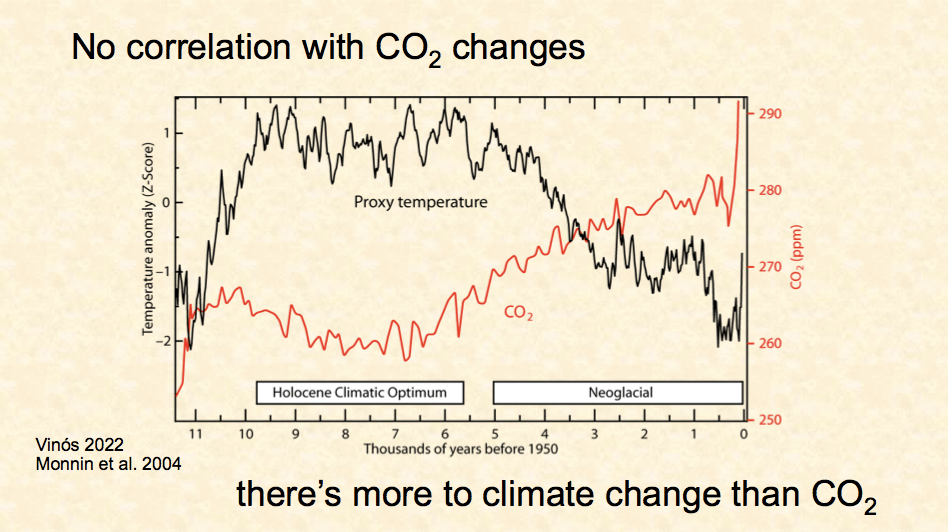
Earth is a dynamic planet with a continuous variation of its climate. The present study has indicated that in their turn the atmosphere, the lithosphere and the biosphere of Earth change constantly through complex mechanisms affecting the climate. Many of these changes are unpredictable, enormous and sometimes sudden. It is certain that such natural climate-changes—both cooling and warming—will occur again and again in the future. Studying the climate record indicates that the 20th-century changes fall well within frequently seen past natural variations. It is our view that there is not yet sufficient let alone rigorous evidence that anthropogenic CO2-increase is indeed the main factor contributing towards the global warming of the 20th-century. This conclusion is supported by a mere study of the inconsistent related literature, reinforced by our analysis on the (probably more reliable and thus far overlooked) chemical CO2-records, essentially showing that one cannot be positive for a relationship between temperature difference and CO2-concentration. On the contrary, the conclusions using the adiabatic theory show that global warming due to atmospheric CO2-increase is impossible. Our study also points that even when the presence of CO2 concentration in the atmosphere was at levels much higher than today, the temperature still considerably fluctuated. Regardless of CO2’s role on global warming, CO2 is a key factor for biological activity that has generally benefited because of the increase observed in the last century. The change of CO2-concentration in the atmosphere through the geological aeons has caused adaptation in plants. At the beginning of their evolution the plants had no leaves, in the next stage they produced leaves and captured CO2 very effectively producing large deposits of coal, and in a final stage they changed their efficiency in photosynthesis to survive in a deficient environment. Palaeo-climatological data show that the atmospheric content of carbon in this geological epoch is at its minimum value. Science today still does not really offer an adequate scheme toward understanding the Earth’s complex climate system. It is therefore our belief that temperature is significantly affected by natural factors that have not yet been adequately assessed or even identified. For example, one could think of water’s role, as water is predominantly present on land, in the ocean and in the atmosphere, as well as the Sun as the main driving forces of climate. Both of these factors are rather poorly understood at present.
End of the citations from this very comprehensive report.
It looks to me that the approach that was used here to evaluate the effect of more CO2 in the atmosphere is very similar to that of Robert Holms, see his report:
Recent Comments