By Henry Pool.
Someone recently asked me what dominant factors influence the temperature around us. It’s an interesting question worth considering.
The influence of the sun
First of all, there’s the variation in solar irradiance. Most scientists, myself included, generally believe that the variation in total solar energy varies little within the average human lifespan, which is 87 years. Ten years ago, I conducted an extensive statistical analysis of daily data from 54 weather stations (WS), namely 27 WS in each hemisphere, more or less balanced at 0 latitude. I reasoned that maximum temperatures would be a good proxy for solar radiation allowed through the atmosphere. From all these results from the period 1974 through 2014, I constructed the following graph for Tmax (globally), for the acceleration or deceleration of Tmax (you simply plot the measured rate of change at certain points against time):
Image 1: My finding at the time was that the maximum temperature per decade had gone negative, approximately 17 or 18 years ago, measured from 2014, i.e., 2014 – 18 = 1996. In 2015, I was therefore fairly convinced that all the hype about global warming would soon disappear if the global average temperature (median) started to fall again. Curiously, that hasn’t happened, as the following graph shows. My conclusion is that all the extra heat measured from 1996 onwards – that is, approximately from -0.2 to +0.4 = 0.6C – must have come from somewhere other than the sun; see the graph below:
Image 2

The urban heat island effect (UHI)
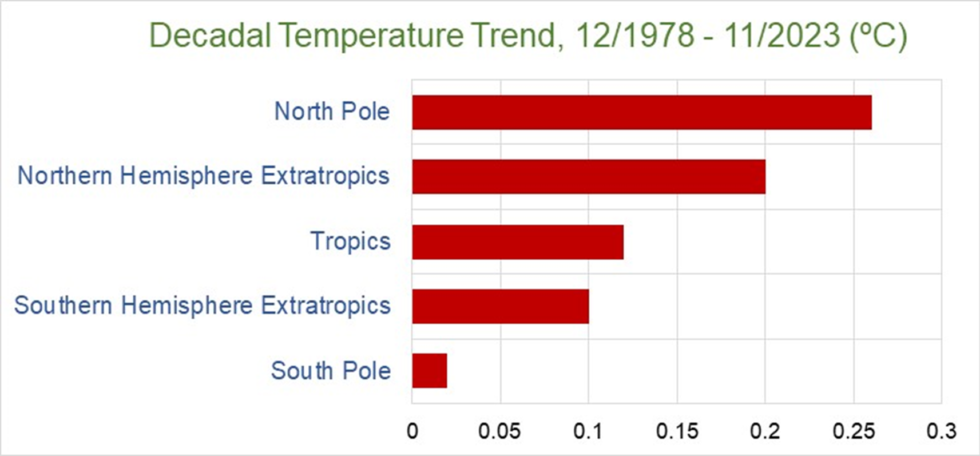
In my opinion, the biggest factor causing the temperature increase around us is the so-called UHI effect. It’s caused by the increasing number of buildings, pavement, and asphalt that trap heat. This includes solar panels and wind turbines. The rivers and waterways around us are also getting warmer due to all kinds of human activities that require cooling water. Willie Soon and others have conducted an evaluation of the contiguous US states and measured a difference of +0.05K per decade between 20% of the most densely populated residential areas and 20% of the most remote areas. Densely populated residential areas yield results that are on average 1.8 times higher. This is significantly higher than the <10% that the IPCC attributes to the UHI effect. See Figure 3 below. Willie Soon says: “Since 2011, more than half of all humanity has become urbanized. So it’s quite understandable that most people are experiencing noticeable “warming” in their surroundings. I found that only East-London, Johannesburg and Cape Town showed some discernable warming, see
No change in temperature in South Africa for more than 45 years! | Bread on the water
But we mustn’t forget that the total area of all cities is still only about 3-4% of the total land area. And that’s where 75% of all weather stations are located… So you can clearly see here that the UHI effect is much larger than 10%.
Image 3 Geological and volcanic activity
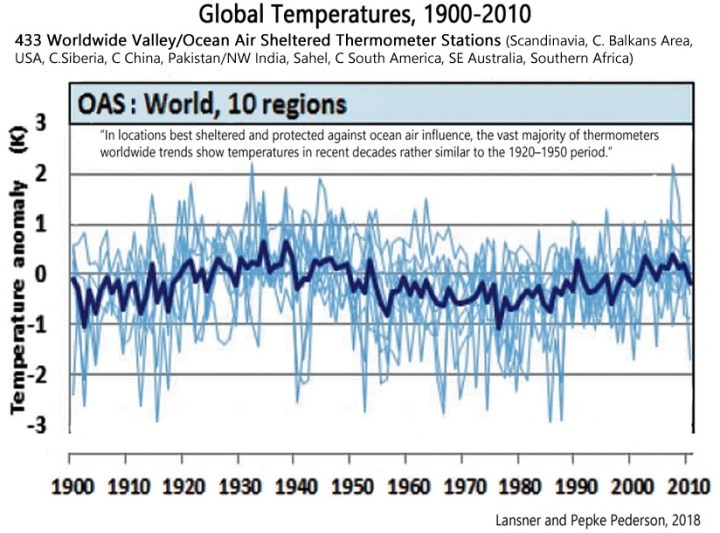
We sometimes forget that 70% of the Earth is covered by water, and that therefore 70% of all volcanoes are underwater. We’ve seen much more volcanic activity recently, for example, in and around the North Pole, Iceland, the Mediterranean Sea, the Black Sea, the Canary Islands, etc. This has demonstrably led to higher water temperatures. See Footnotes 1a and 1b. The large spikes in Figure 2 are due to El Niños, and that is therefore part of the extra warmth since 1996. Scientists are familiar with the “ Ring of Fire ” in the Pacific Ocean and are also noticing increased volcanic and geological activity there. New insights indicate that El Niños originate here. See Footnotes 2a and 2b.
Going back in time, we see a clear, sharp warming trend every 1,000 years when analyzing ice cores (Greenland). See Figure 4 (the graph extends to 1950). Note that within a few decades, the decline is just as sharp as the increase. For more on the 1,000-year Eddy cycle, see Footnote 3.
The most reasonable explanation for this pattern is a combination of additional solar and volcanic activity.
Image 4

The shifting of the Earth’s core
We’re measuring a clear shift in the magnetic north pole. This shift is happening so rapidly that it’s affecting the quality of all our GPS systems. See Figure 5. It’s plausible to associate this with a change in the sun’s magnetic field—the hot, swirling, churning iron in the Earth’s core is aligning itself more with the sun’s much stronger magnetic field.
Image 5

Furthermore, I also saw from my own 2015 results that the minimum temperatures in the Northern Hemisphere (NH) rose by 0.238K/decade, while in the SH they fell by -0.138K/decade (see footnote 4). This was for the period 1974 to 2015. At the time, these results convinced me that global warming cannot be caused by greenhouse gases. Because if you place greenhouse gases in a container, together with oxygen and nitrogen, they behave ‘ideally’, meaning they distribute evenly throughout the available volume. We should therefore see more or less the same delay in heat transfer due to GH gasses everywhere on Earth. But the difference in change between minimum temperatures in the NH and minimum temperatures in the SH is large. Such a large difference, in my opinion, cannot be explained by anything other than a shift in the Earth’s interior. Numerous drilling samples show that the temperature rises by approximately 31°C or 31°K per kilometer downward, on average. See Footnote 5. To achieve a change of 0.6 degrees (minima), you essentially only need a shift of 0.6/31 x 1000 = 19 meters. If it goes up somewhere, it must, of course, go down somewhere else… this possibility would explain the decrease in minima in the southern hemisphere. It would therefore also partly explain the additional warming in the northern hemisphere.
Environmental pollution decreases, the air becomes cleaner
Due to legislation regarding SOx (g) and NOx (g), especially when burning fossil fuels like gas, oil, coal, and diesel, our air is significantly less polluted by SOx and NOx from human activities. These gases are linked to acid rain and cooling, among other things. See Footnote 2b.
Cars, aircraft and shipping are now also required to emit less soot:
a) Soot and particulate matter settling on ice or snow is associated with melting ice in Greenland and the Arctic
b) Soot and particulate matter that remain suspended in the air are associated with increased cloud formation. Cleaner air with less particulate matter therefore actually results in fewer clouds and, consequently, more sunshine.
Variation in cloud formation
When air cools below its dew point, water vapor condenses on microscopic particles present in the atmosphere, creating a cloud. This cloud consists mostly of very small water droplets and ice crystals, 10 to 20 µm in diameter. As these cloud particles grow larger, rain forms. Clouds reflect more of the sun’s heat back into space, making them cooler.
In his 1997 paper “ Variation of cosmic ray flux and global cloud coverage, ” Henrik Svensmark reports that cloud formation also depends partly on the amount of cosmic radiation the Earth receives from the sun and stars. This radiation creates charged particles in the atmosphere, on which water vapor then condenses. See Footnote 6.
What is the effect of the extra greening of the Earth?
John R. Christy wrote in 2006:
Our results indicate that the central San Joaquin Valley has experienced a significant increase in minimum temperatures ( ∼3 ° C in JJA and SON), an increase not observed in the adjacent Sierra Nevada. Our working hypothesis is that the rapid warming of the valley is driven by the massive expansion of irrigated agriculture . Such human engineering of the environment has transformed a high-albedo desert into a darker, wetter, vegetated plain, altering the surface energy balance in a way that we believe produced the results found in this study. See Footnote 7.
During my statistical analysis of 54 weather stations in 2015, I indeed encountered two weather stations with somewhat puzzling results. In statistics, we call these results “outliers.” In the case of Las Vegas (USA), I noted that the minimum temperature has risen by 5 degrees Celsius since 45 years ago, causing the average temperature to rise by almost 3 degrees Celsius. In the case of Tandil (ARG), we see that the minimum temperature fell by 2.2 degrees Celsius over the same period, causing the average temperature to also fall by almost 2 degrees Celsius. See Footnote 8. It is clear that natural water has been brought in from afar in Las Vegas, transforming a desert area into an oasis. Satellite images reveal that large quantities of trees have been felled in the area around Tandil in Argentina.
So it turns out that vegetation has a clear influence on the temperature around us, possibly due to a change in albedo, which is the reflection of light from Earth back into space.
The influence of carbon dioxide
By looking only at the optical properties of carbon dioxide, I had already discovered that the net effect of more carbon dioxide in the air is essentially nothing. See Footnote 9. However, there’s an easier way to determine this. You can rework the ideal gas law PV=nRT to T=P/[R x ρ/M] (1). See Footnote 10.
Where: T = temperature; P=pressure at the surface; R= the gas constant: 8.314; ρ=the density of the air at the surface in kg/m3; M= the average molar weight of the air, also measured at the surface.

Henry Pool.
We can now perform some interesting calculations. What are the average pressure and density at the surface of the Earth? And what is the average molar mass of air near the ground? It turns out to be 101.3 kPa, 1.225 kg/m³, and 28.97, respectively. We plug all of this into our formula (1). It comes out to 288.14K. What happens if we shift CO2 to 0.06% (this is a doubling of the pre-industrial level of 0.03% v/v)? The parameters now become: 101.33 kPa, 1.226 kg/m³, and 28.98. It comes out to 288.11K. The difference is approximately -0.03K.
There is a lengthy discussion of the correctness of this method in Robert Holmes’s report, Footnote 10.
***





Recent Comments