
The other day I read a post written by Dr. Kelvin Klemm from Stratek Global (Pty) Ltd. It starts off like this:
‘Electricity is the lifeblood of the country. If it stops flowing, the economy immediately starts to decay. The average citizen notices it immediately when the electricity stops flowing, because the kettle does not work, and the lights go out. Oviously there is an instant public reaction.
The public demands ‘a solution’. So people look for a ‘quick-fix’.
Unfortunately, it is not so easy; generating electricity is far more difficult than people realize. Coal power stations are huge; you can park a couple of Boeings inside one, easily. But the public wants a quick-fix to an electricity shortage so they jump at apparent solutions, such as solar panels and wind turbines. These renewable energy devices are not equal to a huge coal power station, not by any stretch of the imagination. There is also the added problem that solar is only available for part of the day, and not at all at night. Wind is only available when the wind blows, and you don’t know when that will be.
Imagine that you have just undergone open heart surgery and you’re in the Intensive Care Unit; ask yourself; would you rather have the Intensive Care Unit attached to solar and wind power, or rather attached to coal or nuclear power? If you are a miner working two or three kilometers underground in an inherently hot, dusty gold mine, that same question is most important too!’
The current energy crisis is a huge problem and if we do not solve it soon, it will lead us into all kinds of other problems, in all kinds of fields, from healthcare to agriculture. Who wants to get operated on in a hospital when the power fails? Obviously, you can expect rising food production costs because the farmer now has to irrigate his land with pumps connected to diesel generators. This diesel is currently very expensive. And so the list goes on and on of more and more industries seeking exemption from load-shedding. But that puts a bigger burden on other industries. The end result will be rising inflation and more and more poverty.
I did already propose one solution for the crisis, namely, instead of scrapping the old coal-fired power stations that do not have the sulfur swiping ability that is required, they could be re-furnished to run on gas, see here:
North, south, east, west: Gas best! | Bread on the water
Truly, it seems the only other option that we have is clean nuclear energy. South Africa built the Koeberg nuclear power station to supply electricity from the South ‘upwards’ to complement the coal-supplied electricity coming from the North ‘downwards’, but there is still a huge space in-between which includes points of high electricity consumption such as large mining complexes and major manufacturing centres.
So in 1993 a decision was made to start investigating the potential in developing a Small Modular Reactor (SMR) to be placed in South African areas in which there were no major supplies of water. South Africa has minimal spare inland water. So South Africa became the first country in the world to start designing a commercial Pebble Bed Modular Reactor (PBMR). The project grew to a significant size, with a total workforce of some 2,000 people, and by 2008 the reactor was ready to be built. The pressure vessel was ordered and it arrived in South Africa.
But 2008 was an ominous year.
That was the year of the great US-induced international financial meltdown when major US banks went bankrupt, and it was only a few months later in the following year that South Africa had an abrupt change of government. Those factors, and a few others, led to the PBMR project to be put into a ‘Pause mode’ not long after, from which it never emerged. Anti-nuclear propaganda worldwide was also in full swing, which very much influenced decisions.
The HTMR-100 Emerges
What positive action did happen as a result of the PBMR programme is that a group of engineers and scientists from the PBMR project started their own project to design a cheaper, simpler, and faster-to-build reactor as a derivative of the PBMR.
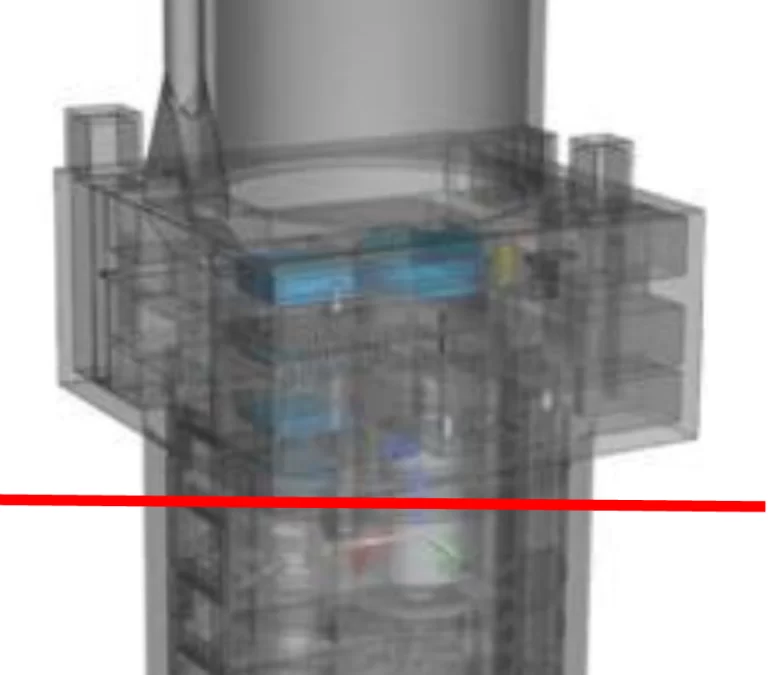
It was called the HTMR-100. See picture below and at the beginning of this post. Below the red line is underground. Over the following number of years the HTMR-100 was designed to the point at which it has been ready to build since 2020. The HTMR-100 is privately owned but requires significant funding to move into construction of the First Of A Kind (FOAK) model. The beauty of this SMR is that is does not need cooling water. It is a gas cooled nuclear reactor. That means it could easily be placed in, at or near coal fired power stations that need to be scrapped because of their lack of proper sulfur removal ability. That way you could still use the infra structure that is available there to distribute the electricity.

A few African leaders have made powerful public statements about their intention to take their countries on a nuclear path. It is possible, by using Small Modular reactors which do not need large scale water cooling. African countries can also easily form a collaborative ‘club’ to link to each other with daily operations, training, and regulatory oversight, amongst other functions. Such an approach will lower costs further and also induce a spirit of cooperation which will be beneficial to all.
Advanced countries have also shown great interest in SMR systems to use in specific applications, or for smaller areas such as municipalities, or specific industrial applications.
The HTMR-100 is now ready to be build. Compared to coal and patrol which only produce 24 and 46 mega Joules per kg, respectively, Uranium gives us 76 million mega Joules per kg! The enriched fuel is produced in South Africa.
Investors just need to have the confidence in an advanced energy solution development coming from Africa. Some established mindsets need to change. The SMR from South Africa is an investment opportunity waiting for people with vision, and some courage, and who also have self-confidence, and a belief in abundant and reliable green power for the future. I even think that in the end, our current discomfort with load-shedding, could turn into a profit and a much desired (green) export product. Remember the oil-boycott? Except for the directors and many people working at SASOL, I remember that it was the tax payers of South-Africa who lend the State some extra money to get patrol from coal. I am sure we can do it again. In fact, I think it is the only possible solution out of the current energy crisis. The sun and the wind are only pipedreams. They cannot supply the amount of power we really need.
Let’s go nuclear.
More info here: 3D-scale model of the HTMR-100 SMR nuclear complex (esi-africa.com)
Feel free to use any or all of the information that is given for your own work or project. However, it would be nice that if you do, you will consider making a donation to our charity. We raise funds for orphans and abandoned children to be raised in good homes. More information here:
https://heartforchildren.co.za/
This post has been published today in the Dutch language, in the Netherlands!
https://www.climategate.nl/2023/03/kernenergie-in-zuid-afrika/