
I recently came across this paper by Antero Ollila:
It is a lengthy report, which is an indication of how difficult the subject is. I just quote its abstract here:
‘An updated effective radiative forcing (ERF) value for constructing a simplified logarithmic forcing equation, and a transient climate response (TCR) value, are presented for CO2, CH4, and N2O. The results are based on line-by-line (LBL) calculations utilizing the HITRAN database and (using) the CERES radiation flux data for fine-tuning. The ERF value derived when doubling the CO2 concentration from 280 ppm (2xCO2) is 2.65 Wm-2 which is in line with the instantaneous radiative forcing (IRF) values of climate models referred to by the IPCC. The difference between the ERF values comes from the stratospheric cooling effect. It is a question about an essential paradigm change of the IPCC approach. In the former 2xCO2 value of 3.7 Wm -2, its portion was about 5 %, and in the present value, it is about 30 %. According to this study, the same effect is 10 %. The updated TCR value is 0.7 ±0.15 °C.’
End of citation.
I have often argued that the warming effect of increased CO2 has never been properly weighed against its cooling effects. Ollila’s analysis and approach appear plausible and correct, or at the very least, in my humble opinion, it moves the controversy around this issue into the right direction. At this stage I am not certain whether he fully accounted for all shortwave (SW) cooling effects caused by CO2 absorption in the 0–5 µm range. Be that as it may, his findings suggest that doubling atmospheric CO2 from the pre-industrial level of 280 ppm to 560 ppm would produce an equilibrium warming of about 0.7 ± 0.15 °C. My chain of reasoning from this paper, assuming all his measurements, assumptions and calculations are correct, is:
(Please note: [CO2] = CO2 concentration, GH = Greenhouse, W=Watt)
2 x [CO2] gives a radiative forcing of ca. 2.65 W/m2 (instead of the conventional 3.7W/m2). Climate-feedbacks are thought to be weak or even slightly negative overall.
So now I calculate the current increase in temperature due to more CO2 as follows:
Pre-Industrial (ca. 1850) = 280 ppm CO2, the doubling = 560 ppm CO2
Currently the [CO2] is 420 ppm. Using the applicable formula, we find the warming from 280 to 420 to be
0.7 x ln (420/280) / ln (2) = 0.41K
Using the confidence levels that Ollila applies, the lower estimate is
ln(420/280) / ln (2) x (0.7 -0.15) = 0.32K,
the upper estimate is
ln(420/280) / ln 2 x (0.7+0.15) = 0.50K
It follows from this, that, according to Ollila, the warming attributable to the increase from 280 ppm to the current 420 ppm amounts to 0.41K +/- 0.09K. Note that I am not saying that man is responsible for all the extra 140 ppm. It is just that all the extra CO2 could have a warming effect of between 0.3K and 0.5K. To put this value into some perspective: it is relatively small compared with the commonly quoted total greenhouse effect of about 33K. Also remember that natural temperature change according to the Eddy cycle, which is currently at or around its peak, could be as much as +2.5K in the northern hemisphere, as shown in the third graph of my report here:
De duizendjarige Eddy-cyclus – Climategate Klimaat
Another point to consider is that, except water vapor, all GH gases behave like ideal gases, meaning that irrespective of their molecular weight the concentration in a vessel is the same everywhere. Therefore, if the observed warming were mainly due to an increase in GH gases, we would expect to see a similar rate of warming everywhere on earth. But the observed warming is in fact not so ‘global’. I refer to the graph below which is a summary of the UAH satellite measurements since 1979.
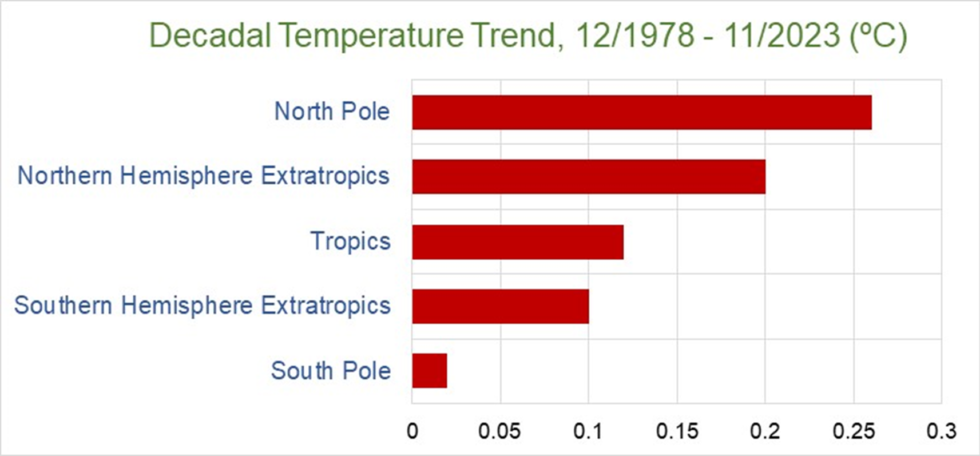
The current result from A.Ollila shows again that warming due to more GH gases is in fact not the major cause or driver of the actual observed warming of earth.
Recent Comments