
By Trevor Underwood
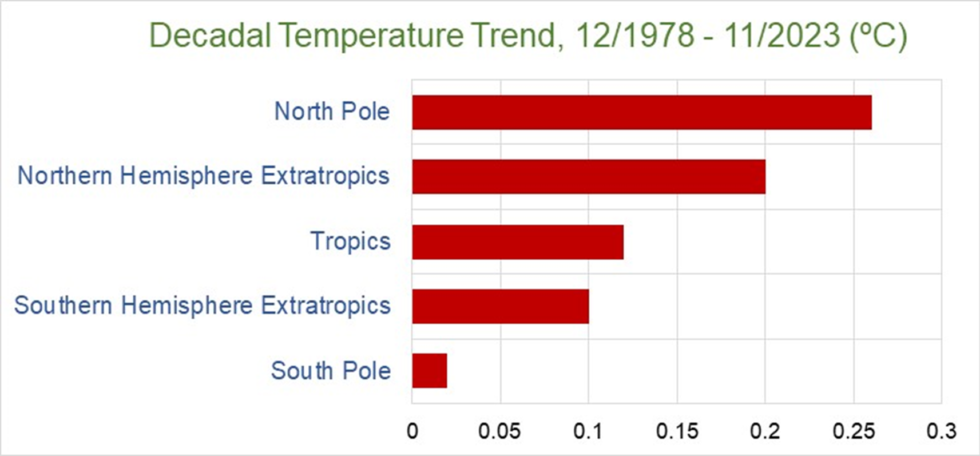
Examination of the radiation budget at the surface of the Earth shows that there are five primary factors affecting the surface temperature; the amount of solar radiation absorbed by the atmosphere and by the surface respectively, the amount of heat emitted from the surface in the form of thermals and evaporation, and the proportion of infrared radiation emitted from the surface directly into space. The Greenhouse Effect equations are solved by calculating the downwelling flux from the atmosphere and substituting this in the equation for the radiative balance at Earth’s surface. If there were no leakage, the upwelling infrared radiation from the Earth’s surface would be equal to the incoming solar radiation absorbed by the atmosphere plus twice the solar radiation absorbed by the surface. At current levels of solar absorption, this would result in total upwelling radiation of approximately 398.6 W/m 2 , or a maximum surface temperature of 16.4°C. Allowing for leakage of infrared radiation through the atmospheric window, the resulting emission from the Earth’s surface due to the Greenhouse Effect is reduced to 372.5 or 388.6 W/m 2 , depending on the treatment of thermals, corresponding to surface temperature of 11.6 or 14.6°C. Absorption of infrared radiation by greenhouse gases is determined by the absorption bands for the respective gases and their concentrations. Examination of the absorption of the black body spectrum of terrestrial infrared radiation after passing through the atmosphere indicates that all emitted radiation that can be absorbed by greenhouse gases, primarily water vapor, with a small contribution from carbon dioxide and ozone, is already fully absorbed, and the leakage of around 5.5 percent corresponds to the part of the infrared red spectrum that is not absorbed by greenhouse gases. Emissions in the carbon dioxide absorption bands are most likely fully absorbed. In these circumstances, increased concentrations of greenhouse gases, and carbon dioxide in particular, will have no further effect. The surface temperature is probably at the thermodynamic limit for the current luminosity of the sun. Satellite based measurements since 1979 suggest that any recent increase in the surface temperature may be due to an increase in total solar irradiance, which we are still a decade or two from being able to confirm.
Recent Comments