

There is an interesting article from Jonathan Cohler on X that I noticed the other day. It starts like this:
The claim is repeated everywhere. Humans caused the modern rise in atmospheric CO2. From about 280 parts per million before industrialization to about 428 today. Case closed.
You will find it in the IPCC assessment reports, on the NASA and NOAA websites, in the annual Global Carbon Budget, in every major textbook. You will also find it in a report titled The Human Contribution to Atmospheric Carbon Dioxide (December 2024), self-published by the CO2 Coalition on its own website and presented on the cover as an official Coalition publication.
Behind that claim are three specific arguments. Recent peer-reviewed work has examined each one. None of the three qualifies at any level as scientific or mathematical proof of what it claims.
Here’s why:
Please take the time to read this. What Jonathan has surmised in his report, I had also already concluded from my own investigations. Back in in 2009 Prof. Endersbee noted a near straight-line linear relationship between the Sea Surface Temperature (SST) and the amount of Carbon dioxide (CO2) in the air. I confirmed that this relationship is still applicable today:
The mystery of the missing human-generated carbon dioxide | Bread on the water
The co-efficient of this relationship leaves very little room for any ‘extra’ CO2 being added by mankind. This means that whatever we add is simply mostly being ‘consumed’ by extra flora and fauna, including more harvests needed by mankind, both on earth and in the oceans, e.g.
https://www.sciencedirect.com/science/article/pii/S2352938524002416
Any remainder of CO2 from mankind is simply mostly being absorbed by the various sinks for Carbon dioxide.
Remember that all (carbon) life depends on the Carbon dioxide gas that is in the air. It’s everything we are and what we eat. We should never forget that. Every year, approximately 100 billion tons of CO2 (1 ton = 1000kg, 1 billion = 1000 million) from the oceans are released into the atmosphere by the heat of the sun (Roemps Chemie Lexicon). To maintain the balance of CO2 in the atmosphere, nature must dissolve a similar amount in places where the water is very cold, for example in the polar regions, the deep sea, etc.
At all levels, the average pressure, pH and temperature determine the (chemical) reactions:
HCO3- + UV/IR heat = CO2 (g) + OH- (1)
CO2 (g) + 2H2O + cold = HCO3- /CO3 — + H3O+ (2)
Billions of tons of bicarbonate and carbonate are dissolved in the oceans. The moon is our stirrer of the water. That is why mixing sometimes takes a little longer. The equilibrium constant K of reactions (1) and (2) determines the CO2 concentration in the air and the equilibrium follows mostly the average temperature of the water. What we put into the air in terms of CO2 apparently disappears almost directly into nature after a few years (more flora and fauna, also for harvesting) or dissolves again in the water, because of the imbalance in the chemical equilibria mentioned. Henry’s law is an intermediate step, but I don’t think that has anything to do with the chemical reactions that take place. The fact that we have never seen a decrease in CO2 in our lifetimes is simply because of:
1) The wastewater from all humans and animals together that eventually ends up in the oceans is usually a little bit acidic, slightly below a pH of 7, on average (Note: reaction 2 equilibrium shifts to the left, as more hydronium ions are entered by human activities). Most countries specify a lower limit of a pH of 6 for wastewater. See footnote (comment)
2) Assuming that the ice at the North Pole is still melting, then the logical conclusion is that this is because the water there is getting or has become warmer, possibly because of more volcanic activity there. As a result, the areas where the CO2 sinks (= dissolves) become smaller. This could be one of the reasons why more CO2 remains in the atmosphere.
3) Thanks to the Eddy cycle, we are still in an upward trend in terms of the temperature of the water (equilibrium reaction 1 shifts to the right), look:
https://www.climategate.nl/2021/03/de-duizend-jarige-eddy-cyclus/
https://breadonthewater.co.za/2021/03/04/the-1000-year-eddy-cycle/
The strong relationship between dCO2 and dSST as reported by prof. Endersbee, suggests that most extra CO2 in the air is due to the extra heat that came into the oceans from more UV/IR from the sun. Heat coming from earth itself due to more volcanic / geological activity, especially underwater, maybe strongly underestimated:
Waar komen El Niños eigenlijk vandaan? – Climategate Klimaat
What drives El Ninos? | Bread on the water
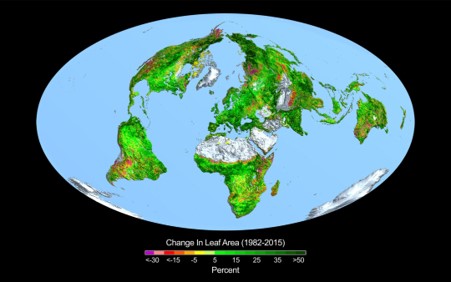
Recent studies suggest that burning less fossil fuels means that it becomes more difficult for the earth to become greener and that with less CO2 in the air we will have smaller harvests.
Make tomorrow greener = please burn more fossil fuel!~ not less. Look:
Dag Henry,
Nog maar een dag of zo, had ik hierover een zware “discussie” met de AI van Google. Uiteraard verdedigt Google het narratief. Ik heb veel tegengas gegeven met de verschillende papers van Koutsoyiannis, over de CO2 cyclus, over 14C, 12C, 13C enz. Telkens de AI een argument had, had ik een andere paper van Koutsoyiannis klaar, want je weet dat die één geheel vormen. Uiteindelijk moest de AI toegeven dat de berekeningen van Koutsoyiannis correct waren, maar AI kwam als enige argument dat wiskunde geen fysica is. Ik heb dan uitgelegd dat de visie van Koutsoyiannis nauw verbonden is met zijn berekeningen, de berekeningen zijn een vertaling van de fysica en de chemie zoals hij die uitlegt. Allerlaatste verdediging van de AI was dat er inderdaad andere manieren zijn om tegen de werkelijkheid aan te kijken…. en dat niemand kan claimen dat zijn eigen visie de juiste is, of dat die van Koutsoyiannis verkeerd is. Ik heb dan gezegd, dat de visie en de parameters en de berekening en de metingen van Koutsoyiannis zodanig kloppen en geniaal in elkaar zitten, dat AI op den duur toegaf dat Koutsoyiannis inderdaad een genie is, maar dat zijn visie “afwijkend” is van andere wetenschappers. Ik heb dan gezegd dat een afwijkende visie niet om die reden verkeerd hoeft te zijn, herinnerend aan de vele keren dat de “consensus” verkeerd was (bv. miasma’s en Semmelweis ) . Toen wilde de AI over een ander onderwerp beginnen.
Endersbee, Salby, Ahlbeck, Easterbrook, Humlum, Hambler en Henderson, Scafetta en Bianchini, Ato, Nelson en Nelson, Koutsoyiannis… en vele anderen, degelijke wetenschappers die niet zomaar het narratief volgen omdat (en dit is belangrijk) hun onderzoek iets anders uitwijst. Dit zijn geen wetenschappers die even dwars willen liggen, of die naam willen maken, want je maakt je op deze manier niet echt populair, integendeel. Dus, deze mensen hebben er echt wel iets voor over om hun oprechte overtuiging, geruggesteund door hun onderzoek, te verkondigen.
We zijn allemaal bezig met een boeiende zoektocht naar de waarheid, maar we hebben al een richting gekozen die ons het meest waarschijnlijk lijkt om tot een goed resultaat te komen.
Dus, doe zo verder.
Hi Rudi.
Thanks for your comment.
I saw of the works of Koutsoyiannis, and agree with it.
i do not agree with using proxies e.g. ice cores, to determine an average dCO2 versus dT (temperature) over a long time (without man) and compare this average to current increase, as we donot know whether the pressure and pH of the water was the same in previous times.
In the end, whatever we do, it is exactly as professor Endersbee proposed, namely, ‘that the oceans regulate the composition of CO2 in the atmosphere’.
As a chemist, I just want to add my own comment to the point 1) I was making about the wastewater.
I don’t think that countries in the far east are too much worried about our specification of pH > 6 for the sewerage. Eventually all acidic and slightly acidic water ends up in the oceans and there are certain results of tests, even from my own samples over the past 10 years from the Indian Ocean here in South Africa, indicating that there may indeed be a very, very small decrease in the total alkalinity of the oceans, especially in the coastal areas. If true, this is what earth itself would do to bring back the balance:
(reaction 2 in reverse):
H3O+ (human) + HCO3- (CO3) = CO2 (g) + 2H2O (a)
However, the oceans contain ca. 1.3 x 10^14 tons of carbonates, not only dissolved as soluble salts, but also as slightly soluble salts or insolubles. These carbonates are all in equilibrium with the surrounding ions, like this:
MeCO3 (s) = CO3– + Me++ (b)
(Me = metal)
removing CO3 from the solution due to reaction (a) eventually leads to equilibrium (b) moving to the right, putting back the ‘missing’ CO3 and bring back the balance.
So now, I do not think we have to worry much as far as yet, but yes, I think we should keep an eye on it.
see also
https://www.climategate.nl/2026/09/over-misvattingen-omtrent-co2/
Anti-greenhouse meaning free convection and no defined system boundaries such as walls a a roof. My green house was over 160F this summer during the days, great sweat lodge after jumping in the Clinch River below Norris Dam. In the 5 years I have been back in this area the tailwaters seem to have cooled by a few degrees and we’re less than published minimum last i checked…Wonder if anyone has been checking tailwater temps at high head hydroplants to see if The Climate Clock is ticking as expected? According to it things should be trending cooler…