
The incomplete definition:
I first try to explain in simple language how the greenhouse effect works. It is important that everyone who has anything to do with this effect at least understands what is happening. This definition was found on the internet somewhere: “it is the capture of the sun’s heat in the lower atmosphere of a planet, because of the greater transparency of the atmosphere for visible radiation from the sun than for infrared radiation emitted from the surface of the planet”. This definition is misleading because it focuses only on a small aspect of the greenhouse effect. This is not the main reason why a planet with water such as Earth is 33 K warmer in the lower regions than a planet without water. Below I show you how the greenhouse effect really works:
- Sunlight (UV/IR) on water (70% of earth) => water vapor
- Water vapor accumulates (sticks together due to strong Van der Waals forces) => clouds
- There is movement of moist air and clouds due to pressure- and temperature differentials => clouds and water vapor move to cooler areas
- Condensation takes place => heat of condensation is released in the air
- The heat of condensation is equal to 2260 kJ per kg.
The above process is the principal mechanism of the greenhouse effect, because it explains how thermal energy is redistributed across the planet. Atmospheric systems such as cold fronts illustrate this redistribution: they transport heat and moisture from warmer regions to cooler regions and thereby contribute to maintaining Earth’s average surface temperature at approximately 14–15°C. Standard textbook definitions now commonly attribute the greenhouse effect primarily to the absorption and delayed emission of outgoing longwave radiation by greenhouse gases. In my assessment, however, that radiative mechanism represents only a limited component of the overall process—perhaps 5–10%, or possibly even less. A rigorous quantitative treatment of this contribution appears to be largely absent from conventional explanations…
The wrong process:
Most atmospheric gases, including nitrogen and oxygen, that make up for about 99% of the atmosphere, allow almost all radiation with wavelengths of 0–25 µm from both the Sun and Earth to pass through unhindered. By contrast, greenhouse gases such as water vapor, carbon dioxide (CO2), methane, nitrous oxide, ozone, and a few others absorb radiation in specific regions of the infrared spectrum, reducing the transmission of light at those wavelengths. For simplicity, our discussion focuses on CO2, because it is produced by burning fossil fuels which is the focus of climate debate. To illustrate, the infrared spectrum of CO2 is shown below:

Fig. 1
We notice that CO2 absorbs at certain wavelengths: most prominently around 4.26 μm and 15 μm. The lesson that we and most students get taught is that when this infrared radiation is absorbed, the CO2 molecule vibrates. Through collisions with oxygen and/or nitrogen molecules, the vibrations are transported to these molecules. Within these molecules, the vibrations are converted into heat, and this is the heat that is supposedly released by the influence of CO2. The common argument is that the continued exposure of light with, say, wavelength 15 μm from both earth and sun, is absorbed, and this absorbed radiation is continuously converted to heat during the interaction and numerous collisions with other gas molecules….
Some observations, related to water, water vapour and water droplets, appear to support this theory. This is all fine! We know that water has absorption in the UV- and the IR regions and that this is converted into heat. This warmth, spread evenly over the planet, sustains our lives on Earth. The point is that with water, there is mass, even if it is just a tiny little drop. The question is whether we can simply assume that the observed effects of absorption of radiation by liquids, namely the appearance of heat, must be the same as with ideal gases.
Since regular measurements of CO2 began, ca. 60 years ago, about 100 ppm of CO2 were added to the atmosphere, from whatever source. Every extra molecule of CO2 is surrounded by 10000 other gas molecules. CO2 acts as an ideal gas, meaning there is no sticking together of molecules due to Van der Waals forces like we have with water vapor. It diffuses equally into all directions of a vessel. There is also no release of heat due to condensation by CO2. At normal pressures and temperatures CO2 does not have a liquid state. According to the relevant gas law there can be no accumulation of that gas in the lower atmosphere, and subsequent condensation, to contribute to the greenhouse effect caused by the water on the planet. In my opinion, one molecule in 10000 has no mass to absorb any heat and pass it on. Any such effect is probably minimal, totally unmeasurable and negligibly small.
So, what does happen to an ideal gas that is irradiated and has absorption in its IR spectrum? Carefully look at Fig. 1. There is no transmission of light with wavelength 4.26 and 15 μm through the molecule. Exposure to specific radiation of that wavelength will not pass through. The proposed theory is that the photons here are re-emitted or re-radiated. Let us call it back-radiation.
This back-radiation by certain substances at certain wavelengths is also the principle of infrared and UV & visible spectrophotometry. I remember that as a student I sometimes secretly lifted the cuvette holder a bit during a determination to see what happens when you turn the wavelength knob on the absorbing wavelength when measuring the standard solutions. I could see that the path of light is obstructed. The light goes back, mostly in the direction of the source, but also a bit round. That is why in my days we used to talk about ‘extinction’. The light does not go through the cuvette, but it goes extinct at the absorbing wavelength. The transmission of the light or radiation through the molecule is obstructed. In spectrophotometry, the degree of extinction at a certain wavelength is therefore an indication of the concentration of a certain component (Lambert-Beer).
At one stage during my employment – I remember this was in fact at the very initial stage of micro chip manufacturing – I was tasked with controlling the incoming quality of nitrogen. One of the tests involved the measurement of CO2 where I used an FTIR spectrophotometer, able to bombard my gas sample with radiation of 4.26 μm. As it happened, the amount of CO2 in the nitrogen was in the range of about 100 ppm. Now, like most of you, I sometimes made the mistake of forgetting….to switch off….. Never mind that, coming back the next morning I always found there was no change. I could repeat the test and still get the same result. Thinking back now, you can imagine that if the theory of those CO2 molecules exposed to 4.26 μm radiation continuously vibrating and turning that absorbed radiation into heat were true, it should affect all nitrogen molecules and eventually the contents of my cuvette should cook or explode…. None of this has ever happened to me during any spectrophotometric measurements that I conducted…..
I also consulted ChatGPT on this and eventually he or she admitted:
‘So your experiment gives you a solid observation—CO₂ strongly attenuates 4.26 µm radiation—but the conclusions about where the absorbed energy goes, need to be tested independently’.
Let us have a look at that! Take note that CO2 also has absorptions in the near infrared region. Scientists can pick up the back-radiation of this via the dark side of the moon. Here is the report:
I show Fig. 6 (bottom) of the abovementioned report:
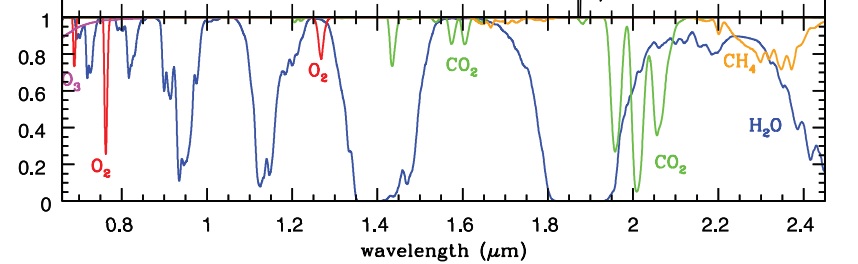
Fig. 2
Schematically, what we see is happening in Fig. 2:
Sunlight to the earth = > absorption of radiation by CO2 (green curve, various peaks between 1.4 and 2.1 um) = > re-radiation back to the source and to space = > therefore also to the moon = >via the dark side of the moon back to the earth = > to the measuring instrument.
We have seen that exposure of greenhouse gas to radiation from the sun and from earth in certain wavelength ranges 0-25 μm cannot go through the molecule because passage through is restricted in certain areas. Whatever the cause: we conclude that in the wavelength ranges where absorption of photons has taken place, the individual gas molecule re-radiates or back-radiates. Most probably you can compare it a bit with a very small spherical mirror, ‘reflecting’ the light at the absorbing wavelength. The strength of this emission depends on the size of the amount of absorption that takes place in the molecule. There has been debate about the distribution of the emission. I consider that you could compare this problem a bit with putting your head lights on in misty or foggy conditions: most of the light is going to the source, i.e. straight back in your face. Assuming:
- that a gas molecule is completely spherical
- that the gas molecules are turning at a certain constant speed, in whatever direction
and knowing:
3. that the surface area of half a sphere is always in a ratio of 2:1 to the surface area of a perfect circle,
it follows that, taken over 180 degrees, 66.7% of a certain amount of light, due to the irradiation of the molecule with light of the absorbing wavelength, is sent back in the direction where it came from. The rest simply just goes around. I don’t agree with the theory that it is simply 50/50.
By my account this is the real so-called greenhouse effect of individual gases that have absorption in their spectra.
The faulty Planck curve:
This is a point that is well known in many sceptical science circles. For official calculations, the electromagnetic radiation spectrum from earth is generally misrepresented as a ‘blackbody’ type of distribution that starts emission at 4 μm. (e.g. see Wikipedia/ KNMI). When I investigated this matter, I went over a few issues, as related below,
- The notion that the average temperature of earth is 288 K leading to the peak of the ‘earthly’ Planck curve being around 10 μm, appears to be totally incorrect. For one thing, the given average of 288 K for Earth does not really include both polar regions and Greenland, due to a lack of weather stations in these areas.
- Flying across the world at an altitude of ca. 10 km, I observed that temperature outside the plane was always around -50C. According to Wien’s law, this corresponds with an outgoing radiation of ca. 13 um. That made me wonder. I considered that a reasonable average for outgoing radiation might be if you looked at it from halfway through the troposphere. Apparently, the temperature in the middle of the troposphere is 247 K, giving (me) an estimated average peak of the outgoing radiation from Earth of ca. 12 μm. That was already a nice shift of 2 μm.
- With Wien’s Law you can calculate that with outgoing radiation at 4 μm, you must have a source of heat of 725 K. The general cooling of earth over the millennia, although maybe not always on a nice downward curve – showing small upward peaks every now and then (some apparent ‘global warming’ observable at regular intervals of 1000 years – just like now – due to the Eddy cycle) and the virtual complete dying down of continuous volcanic activity on land, brought me to thinking that there is absolutely no chance of earth emitting any radiation of a wavelength smaller than 5 μm. This point is quite critical when we observe the infrared spectrum of CO2 (Fig.1). In terms of quantum energy (expressed in eV) the energy back-radiated at 4.26 μm is about 4 times higher than that at 15 μm.
- Eventually, I figured that Earth’s outgoing radiation cannot not be fitted into any Planck curve. The surface of earth is not uniform like a planet such as Mars. It includes vast areas of water, snow and ice, desert, and land – both with and without vegetation. You would expect a discrete function instead of a curve. It was around this time that I came across this graph as presented in a textbook by Petty. It apparently relies on actual measurements that have been carried out. The source is indicated in the description below the graph.

Fig. 3
Fig. 3 clearly shows that the outgoing radiation from earth does not peak at 10 μm and that emission from Earth only starts at around 6 μm!
Discussion and Conclusion
The range of wavelengths relevant to our investigation is from 0-25 μm. We have seen that Earth constantly radiates to space from 6 to 25 μm (various intensities) for 24 hours a day (Fig.3). Our Sun constantly irradiates Earth with light of wavelengths 0-25 μm (various intensities) for 12 hours a day, on average. Given the combined spectrum of CO2 (Fig.1 + Fig.2), it is possible to do a line-by-line analysis, in very small portions of microns (wavelength in μm). In this way it is possible to determine whether the energy due to the back-radiation by CO2 to the Sun and space for 12 hours per day, in the range of 0-25um (the ‘cooling effect’), is smaller than the warming effect due to the back-radiation by CO2 to Earth in the range of 6-25 μm for 24 hours per day. Given careful attention to the issues mentioned above, with no deliberate misunderstandings, e.g. ignoring the various absorptions of CO2 in the near infrared or applying the incorrect emission curve for Earth, you eventually should be able to figure out that the amount of energy back-radiated by the CO2 to Sun and space is just about the same as the energy of the back-radiation by CO2 to Earth. My own results followed by a few typical results are reported below.
https://1drv.ms/x/s!At1HSpspVHO9pws8aNzcnG9n6skv?e=b6IwLG
End result (first 3 rows, columns K,L,M): -0.0063 eV per molecule; i.e. no warming effect by more CO2
End result: -0.03K for doubling of CO2 concentration: i.e. no warming effect by more CO2
End result: no warming by 100% CO2 compared to Argon and air: ‘These findings might question the fundament of the forcing laws used by the IPCC!’
https://principia-scientific.org/industry-experts-co2-worse-useless-trapping-heatdelaying-cooling-2/
End result: After exhaustive experiments Berkeley’s brightest and best reported that “the effect of the infrared radiation properties of CO2 is unnoticeable’.
Microsoft Word – SCC-Koutsoyiannis-Dog&Tail-Nov-2024.docx
“The effect of the (additional) CO2 is quantified at 0.5% for both downwelling and outgoing radiation.’ Essentially this end result can be interpreted as being zero. (I notice for the first time that the downwelling long wave radiation that is returned to the Sun and space by the CO2 has been brought in as a factor).
Recent Comments