+27 83 629-7690

Letter to minister Dr. K.D. Ramokgopa

Could you please forward this message to our minister of electricity, Dr. K.D. Ramokgopa. Thank you.

Dear Dr. Ramokgopa

First of all, my congratulations on your appointment as minister! I wish you God’s richest blessings on your work.

I am a retired chemist and I would like to help you find a quick solution to our energy crisis. I have a college diploma in chemistry and a diploma in Datametrics as well as and many years of experience in the field of data analyses. As a hobby, during my retirement, I looked at some data on climate change. My findings on climate change in South Africa are reported in detail here:

https://www.dropbox.com/s/tps2cd4kuds8o6g/SUBMISSION%20by%20Henry%20Pool.docx?dl=0

Sadly, I did not receive any reply on my submission from the relevant department. I thought that was rather impolite? Fact is, that I could not really find any significant climate change in South Africa over the past 40 years. As far as global warming is concerned, I also found some rather inconvenient truths:

https://breadonthewater.co.za/2021/11/25/an-inconvenient-truth/ 

The above was to just give you some background about me and what I think of the so-called ‘man-made climate crisis’. 

Now, some people, apparently Mr. DeRuyter amongst them, seem to think that we can simply solve our energy crisis with ‘renewables’ like wind and sun.

Unfortunately, it is not so easy; generating electricity is far more difficult than people realize. Coal power stations are huge; you can park a couple of Boeings inside one, easily. But the public wants a quick-fix to an electricity shortage so they jump at apparent solutions, such as solar panels and wind turbines. These renewable energy devices are not equal to a huge coal power station, not by any stretch of the imagination. There is also the added problem that solar is only available for part of the day, and not at all at night. Wind is only available when the wind blows, and you don’t know when that will be. That means that with this type of renewable energy, you still need decent back-up. I am sure that you will agree with me that we simply do not have the luxury for this in South-Africa.

On the issue of using coal (1) for energy I am neutral. However, although carbon-dioxide is not a poison, we know that Sulphur and sulphureous compounds are very poisonous as they can interfere with our breathing. This therefore has to be removed from the exhaust when you burn coal. I understand that they want to scrap the old coal power stations where this is not being done, and where it is not feasible to modify with Sulphur sweeping. My recommendation is not to scrap any of the old coal-fired power stations but to rather re-fit them to run on gas. Apparently, there is a gas pipe running from Mozambique to Sasolburg and it cuts right through the areas where these coal-fired power stations are situated.


Note that gas (2) burns clean and there is no Sulphur so it does not need any Sulphur removal. Also, if you do the calculations, there is a saving of 50% in the emission of CO2 per kWh generated. If you want me to, I can look up the official reports on that. Fact is that with gas as fuel there is a saving of 50% in carbon emission when compared to coal. Note that a country such as The Netherlands, who already have much wind and solar, they still need gas-fired power stations as a back-up.


However, if you would prefer to go 100%  carbon-free,  you should clearly consider the nuclear (3) option. Actually, we are fortunate in South-Africa that a lot of work has already been done on smaller nuclear reactors, like the Pebble Bed Nuclear reactors. The latest development, the HTMR-100 does not need water cooling as it is gas cooled with Helium. My thinking is that they could also be placed in, at or near the old coal-fired power stations so that you can still use the existing network for the distribution of power.

If money is a problem, I can also help you by giving you an idea on how to raise money for such a project:


Let’s go nuclear! | Bread on the water


Dr. Ramokgoda, I hope that you will take note of this letter and that perhaps I will hear from you?

Best wishes,


Henry Pool 

Cel. 0836297690

https://breadonthewater.co.za/blog/

Cel. +27 (0)836297690

henrypool7@gmail.com


Heart for Children (Autumn 2023)

You will recall that we asked your help for the repair of the roof for the Safe house for children in Nellmapius. 

I am happy to report that the work is finished!  Above I show you the pictures of what it looked like before and below I show what it looks like now!

The roof has been repaired and sealed to make it waterproof and the ceiling has been installed. We celebrated the occasion by bringing some sweets and balloons to make our visit to the home a memorable day. See pictures below! Unfortunately, the repair of the ceiling did not include the cornicing and therefore we still need the corner pieces. This will now just have to wait a bit until we have gathered some extra funds together again. 

Jochi Maidi reported that the house is a lot cooler now since the ceiling was installed and she is very happy. We expect it will be a lot warmer during the winter months. On behalf of her and all the children, we would like to thank all of you who made special donations for this project, including our overseas donors and those that contributed via Hart voor Kinderen in the Netherlands. We take this opportunity to also thank all our regular donors of Heart for Children again. It is much appreciated. See OUR BENEFICIARIES | Heart for Children

Please note that I will soon have a small operation on my thumb due to the arthritis, so I expect that I might be a bit indisposed over Easter. Whenever I experience pain, I often think of Jesus and the terrible pain he must have suffered on that cross. I find it helps me to cope and put everything in perspective.

We wish you a blessed Passover and Easter. If you are travelling, we pray that the angels of God will accompany you on your journeys. Please drive carefully!

To read the Easter newsletter from Crystal Cathedral Ministries SA, click on the link below:

Easter 2023! | Bread on the water

Henry Pool  0836297690

Annette Pool 0834696875

To make a donation to Heart for Children, please click here: Donating to Heart for Children | Bread on the water

Easter 2023!

Easter 2023!

Easter tells the most remarkable love story of all time! It is a significant occasion, both of mourning and celebrating. Good Friday (7 April) evokes the darkness, pain and sorrow of Jesus, beaten, bruised and shamed for our transgressions. This in contrast to the light, relief and joy of Easter Sunday (9 April) and Jesus’ victory over death to make a way back to everlasting life for us all. 

Jesus said:

(Joh 14:1)  Let not your heart be troubled: you believe in God, believe also in me.
(Joh 14:2)  In my Father’s house are many mansions: if it were not so, I would have told you. I go to prepare a place for you.
(Joh 14:3)  And if I go and prepare a place for you, I will come again, and receive you unto myself; that where I am, there you may be also.

The hour has come! He is Risen!

I was blessed recently by the sermon of Louis Kotze on Good Friday. Amazing how technology works: you can also watch it now by clicking here:

Best Easter Sermon! | Bread on the water

If you don’t have the time, then click on watching this video. It just takes the 5 minutes to watch it.

 Be careful of a new false god (christ) that is trying to gain foothold in many of our good Christian churches. Gretha Thunberg was recently made a Doctor of Theology of the University of Helsinki. She did not even finish school. More about this here:

https://breadonthewater.co.za/2022/06/27/the-green-religion/

We are experiencing again some trouble with our broadcasts on the internet, now due to the breakdown of our main computer. However, we will do our best to keep putting up a new program every fortnight on the BreadOnTheWater channel.

See: https://breadonthewater.co.za/ccmsa/

Note that I will soon have a small operation on my thumb due to the arthritis, so I expect that I might be a bit indisposed over Easter. Whenever I experience pain, it helps me to think of Jesus and the terrible pain he must have suffered on that cross. Somehow this does help me to cope and put everything in perspective.

We wish you a blessed Passover and Easter. If you are travelling, we pray that the angels of God will accompany you on your journeys. Please drive safely!

To read the latest newsletter from Heart for Children SA, click on the link below:

Heart for Children (Autumn 2023) | Bread on the water

Henry Pool

0836297690

To make a donation to CCMSA, please click Donating to CCMSA | Bread on the water

Let’s go nuclear!

Let’s go nuclear!

The other day I read a post written by Dr. Kelvin Klemm from Stratek Global (Pty) Ltd. It starts off like this:

‘Electricity is the lifeblood of the country. If it stops flowing, the economy immediately starts to decay. The average citizen notices it immediately when the electricity stops flowing, because the kettle does not work, and the lights go out. Oviously there is an instant public reaction.

The public demands ‘a solution’. So people look for a ‘quick-fix’.

Unfortunately, it is not so easy; generating electricity is far more difficult than people realize. Coal power stations are huge; you can park a couple of Boeings inside one, easily. But the public wants a quick-fix to an electricity shortage so they jump at apparent solutions, such as solar panels and wind turbines. These renewable energy devices are not equal to a huge coal power station, not by any stretch of the imagination. There is also the added problem that solar is only available for part of the day, and not at all at night. Wind is only available when the wind blows, and you don’t know when that will be.

Imagine that you have just undergone open heart surgery and you’re in the Intensive Care Unit; ask yourself; would you rather have the Intensive Care Unit attached to solar and wind power, or rather attached to coal or nuclear power? If you are a miner working two or three kilometers underground in an inherently hot, dusty gold mine, that same question is most important too!’ 

The current energy crisis is a huge problem and if we do not solve it soon, it will lead us into all kinds of other problems, in all kinds of fields, from healthcare to agriculture. Who wants to get operated on in a hospital when the power fails?  Obviously, you can expect rising food production costs because the farmer now has to irrigate his land with pumps connected to diesel generators. This diesel is currently very expensive. And so the list goes on and on of more and more industries seeking exemption from load-shedding. But that puts a bigger burden on other industries. The end result will be rising inflation and more and more poverty. 

I did already propose one solution for the crisis, namely, instead of scrapping the old coal-fired power stations that do not have the sulfur swiping ability that is required, they could be re-furnished to run on gas, see here:

North, south, east, west: Gas best! | Bread on the water

Truly, it seems the only other option that we have is clean nuclear energy. South Africa built the Koeberg nuclear power station to supply electricity from the South ‘upwards’ to complement the coal-supplied electricity coming from the North ‘downwards’, but there is still a huge space in-between which includes points of high electricity consumption such as large mining complexes and major manufacturing centres.

So in 1993 a decision was made to start investigating the potential in developing a Small Modular Reactor (SMR) to be placed in South African areas in which there were no major supplies of water. South Africa has minimal spare inland water. So South Africa became the first country in the world to start designing a commercial Pebble Bed Modular Reactor (PBMR). The project grew to a significant size, with a total workforce of some 2,000 people, and by 2008 the reactor was ready to be built. The pressure vessel was ordered and it arrived in South Africa.

But 2008 was an ominous year.

That was the year of the great US-induced international financial meltdown when major US banks went bankrupt, and it was only a few months later in the following year that South Africa had an abrupt change of government. Those factors, and a few others, led to the PBMR project to be put into a ‘Pause mode’ not long after, from which it never emerged. Anti-nuclear propaganda worldwide was also in full swing, which very much influenced decisions.

The HTMR-100 Emerges

What positive action did happen as a result of the PBMR programme is that a group of engineers and scientists from the PBMR project started their own project to design a cheaper, simpler, and faster-to-build reactor as a derivative of the PBMR.

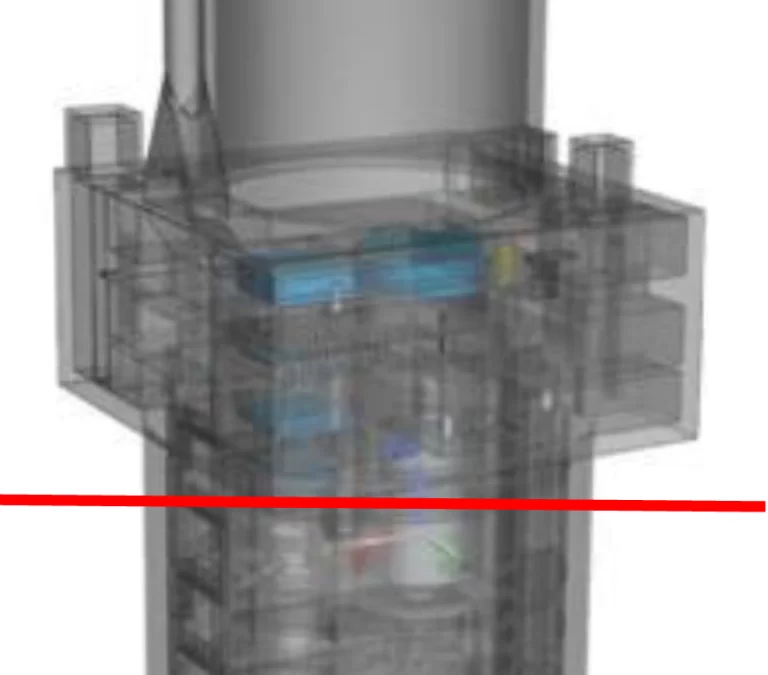
It was called the HTMR-100. See picture below and at the beginning of this post. Below the red line is underground. Over the following number of years the HTMR-100 was designed to the point at which it has been ready to build since 2020. The HTMR-100 is privately owned but requires significant funding to move into construction of the First Of A Kind (FOAK) model. The beauty of this SMR is that is does not need cooling water. It is a gas cooled nuclear reactor. That means it could easily be placed in, at or near coal fired power stations that need to be scrapped because of their lack of proper sulfur removal ability. That way you could still use the infra structure that is available there to distribute the electricity.

A few African leaders have made powerful public statements about their intention to take their countries on a nuclear path. It is possible, by using Small Modular reactors which do not need large scale water cooling. African countries can also easily form a collaborative ‘club’ to link to each other with daily operations, training, and regulatory oversight, amongst other functions. Such an approach will lower costs further and also induce a spirit of cooperation which will be beneficial to all.

Advanced countries have also shown great interest in SMR systems to use in specific applications, or for smaller areas such as municipalities, or specific industrial applications.

The HTMR-100 is now ready to be build. Compared to coal and patrol which only produce 24 and 46 mega Joules per kg, respectively, Uranium gives us 76 million mega Joules per kg! The enriched fuel is produced in South Africa.

Investors just need to have the confidence in an advanced energy solution development coming from Africa. Some established mindsets need to change. The SMR from South Africa is an investment opportunity waiting for people with vision, and some courage, and who also have self-confidence, and a belief in abundant and reliable green power for the future. I even think that in the end, our current discomfort with load-shedding, could turn into a profit and a much desired (green) export product. Remember the oil-boycott? Except for the directors and many people working at SASOL, I remember that it was the tax payers of South-Africa who lend the State some extra money to get patrol from coal. I am sure we can do it again. In fact, I think it is the only possible solution out of the current energy crisis. The sun and the wind are only pipedreams. They cannot supply the amount of power we really need.

Let’s go nuclear.

More info here: 3D-scale model of the HTMR-100 SMR nuclear complex (esi-africa.com)