+27 83 629-7690
CO2, temperature and weather

CO2, temperature and weather

By Russ Babcock.

During this summer of 2023 (NH), we witnessed catastrophic wildfires in Hawaii, western and northern Canada, and the northwestern United States, burning not only hundreds of square miles of oxygen-producing forests, but also communities in major cities, small towns, and villages were hit, while right next door, in a neighboring state, we saw hurricane-force downpours, and devastating flooding of several towns and villages.

We are expected to believe that this is all caused by an increase in CO2 concentrations in the atmosphere from 0.03% to 0.04%, according to the madness promoted by governments and their mouthpieces in the mainstream media – and all this in the absence of any evidence. They just put their bold label on it: climate change. That’s reason enough for them, and it’s suggested that it should be reason enough for the rest of us.

Before this astronomical (😏 ) CO2 increase of 0.01%, average temperatures on Earth were ~0.9 degrees Celsius lower than today. It is fair to say that no one knows exactly how much (if anything measurable) of that 0.9 degree increase is due to the 0.01% increase in CO2 concentration. But we all know that half of the 0.9 degree rise in temperature occurred before fossil fuel planes flew. Cars, trucks, trains, ships and buses have only been in use since about the middle of the 20th century. That should be a clue to rational thinking people, whether they understand the underlying science or not.

The honest consensus on the causes of climate change among real and legitimate scientists who actually study potential causes of changes in global temperatures and climates in scientific detail, is probably much closer to zero. Even the total temperature increase of 0.9 degrees over the past 125 years would not be a reason for catastrophic weather events such as droughts, hurricanes, storms, El Niños, heat domes, atmospheric rivers, etc.

There are many other reasons for such events that are scientifically more probable than a 0.01% rise in the concentration of CO2 in the atmosphere, or any part of a 0.9 degree rise in global average temperature. In short, catastrophic weather events result mainly from physical interactions between adjacent climates, and to a lesser extent from sudden and significant tectonic changes (e.g. volcanoes).

There are many science-based causes for changes in the Earth’s average temperature, both at the Earth’s surface and at different altitudes in the atmosphere, and even more reasons for constant changes in the many climates around the world that exist simultaneously. But the proponents of the man-made climate change narrative (also called anthropogenic global warming, or AGW), have a major influence on politics and the media through their financial resources and ownership of newspapers, radio and TV-stations.

With that control, they can prevent public discussion about scientific reasons and causes of global temperature and climate changes. Or at least they make it extremely difficult for really well-informed scientists to have fruitful communication links with the general public. The megaphones of the mainstream media are the gateways to the minds of the voting population. It appears that the alternative voices about anything to do with climate change are off limits to main stream media (MSM).

So that’s the problem. Getting the media to side with the truth is the first step in the overall solution of the problem. The problem will be solved when the public is informed enough to vote the bad guys out of office, and replace them with people who are not out to destroy our personal freedoms, our free enterprise production, our democracy, our national sovereignty, our way of life – all of which apparently need to be ‘reset’

https://theconversation.com/profiles/russ-babcock-126401

Wind energy isn’t working!

Wind energy isn’t working!

By Gordin Hughes. Source here: Wind costs will remain high (netzerowatch.com)

The share price crash of Siemens Energy has strikingly exposed a problem with wind energy costs that colleagues and I have been investigating for more than a decade. The painful facts are that (i) wind power generation, both onshore and offshore, is more expensive than we’re told and (ii) wind turbine performance tends to deteriorate as they age, largely because of the type of failures Siemens Energy has been identified. There is strong evidence to support these conclusions, which has been presented in reports published by the Renewable Energy Foundation in 2012 and in 2020 for the UK   Denmark, with updates from the Global Warming Policy Foundation and Net Zero Watch .

The news about Siemens Energy evokes a strong tendency to say ‘you were warned’. Their trials, however, are a symptom of a more widespread disease, affecting all of us, either directly through the cost of electricity or indirectly as wind farm owners (through pension funds and other investment vehicles). Siemens Energy’s share price decline is dramatic, but that can be written off as a temporary market reaction to disappointed expectations. We need to dig a little deeper to understand the reasons for the disappointment and their implications for the outlook for wind energy.

The announcement by Siemens Energy targeted higher-than-expected failure rates for their onshore turbines. These were attributed to problems with key components, but newspaper reports suggest more systematic design flaws in recent generations of large turbines. Previous announcements have focused on problems with offshore turbines, and the market reaction suggests that few believe the current problems are limited to onshore turbines. Further, while each of the major turbine manufacturers has its own specific issues, Siemens Energy is not alone in facing high warranty costs due to higher-than-expected failure rates.

In ascending order of importance, there are three aspects to pay attention to:

(a) Siemens Energy and other manufacturers have made warranties of performance that will not be met due to higher failure rates. They will incur additional costs, either to replace components or to compensate wind farm operators for any resulting underperformance. Those costs are the basis for the depreciation that Siemens Energy had to take. Investors will be painfully aware that the company is declaring profits on wind turbine sales, but without making adequate provisions for future warranty repair costs. In accounting terms, this is known as recognizing future profits for new business. When it becomes clear that the contracts will be less profitable, the company has to write off the value of previously reported profits and therefore the value of the assets on its balance sheet. In fact, though perhaps wholly unknowingly, the company has misled investors about its past and present profitability. Senior managers should feel very uncomfortable about their position as the problem was predictable (and predicted).

(b) Warranties have a limited period – often 5 to 8 years – but the higher failure rates will persist and affect performance over the remainder of the life of the wind farms where the turbines are installed. Their future operating costs will be higher than expected and their output will be significantly lower. This will shorten their operational life, which is determined by how the margin between revenues and costs changes as wind farms age. Lower revenues and higher costs bring forward the date when replacement or repair is required. These changes will often significantly reduce the returns of the financial investors – pension funds and others – to whom operators sell most of the shares in wind farms after a number of years.

(c) Siemens Energy and other manufacturers can claim that they can – over time – solve the component and design problems that lead to high failure rates. They could be right. The history of power engineering is littered with examples of new generations of equipment that encountered major problems when first introduced, but were eventually resolved. Many companies have run into serious financial difficulties or even went bankrupt due to these “teething problems”. The mistake in this case was to pretend that wind turbines were immune to such disturbances. The whole justification for the falling cost of wind generation rested on the assumption that much larger turbines would produce more output at a lower cost per megawatt, without the high cost of generation change. Now we have confirmation that such optimism was completely unjustified – the whole development process was a case of too far, too fast. Again, this was both predictable and predicted.

The idea that wind turbines are immune to the factors that influence other forms of power engineering has always been absurd. As a result, both capital and operating costs for wind farms are not falling as fast as claimed and may not fall significantly at all. It follows that current energy policy in the United Kingdom, Europe and the United States rests on quicksand – naive optimism reinforced by enthusiastic lobbying detached from technical reality.

In the longer term, (b) and (c) are the big story. With regard to (a), serious analysts have long recognized that claims about future wind costs and performance by the wind industry should not be taken seriously. It is clear that they have been fooling themselves and their investors since the last 2010s. Unfortunately, we are now bound by a future with high energy costs, with all the consequences for the economy and living standards.

Atlantis Rising?

I was still a teenager when I first heard the song about Atlantis. By clicking on the youtube music link below, you can also listen to it. (Don’t forget to click on the start triangle, below left). I think that from that time onward I have indeed always been fascinated by everything and anything that had something to do with that lost paradise, the land of Atlantis. 

Atlantis song

by Donavan | Barabajagal -Donavan

https://music.youtube.com/watch?v=GjbWxRM9H2U

The day when the sea swallowed Atlantis has haunted men’s imaginations down the centuries. It seems the legend originated from a priest in ancient Egypt. Plato (ca. 400 BC) is our main source. He describes the splendor and greatness of the capital of Atlantis in stunning details. But in the end the Atlantean society began to decay as people started to worship the false gods of wealth, idleness and luxury. He writes: “When the divine portion began to fade away and the human nature gained upper hand, they then behaved in an unseemly manner.” It was during this era of corruption that the Atlanteans embarked on a world conquest launching huge fleets against other lands and islands. He relates that therefore (the) God(s) had prepared  a terrible retribution for the men who had betrayed the ancient faith of Atlantis. Plato says: “There occurred violent earthquakes and floods; and in a single day and night of misfortune ….the land of Atlantis disappeared into the depths of the sea.” According to Plato’s account, all this happened in remote antiquity, some 12000 years ago. He located Atlantis in the Great Ocean, the Western sea, beyond the Pillars of Hercules which we know today as the Straits of Gibraltar (From: The World’s Last Mysteries, page 16).

Must say: don’t you find Plato’s writings strikingly similar to those in the Bible relating to Noah’s flood? I am also reminded of the words of our Lord (Jesus) in Matthew’s Gospel, “As it was in the days of Noah, so will be the coming of the Son of Man. [The Son of Man is the way Jesus often referred to Himself. So, He is talking about the end of earth and His coming at the end of time]. For as in those days before the flood they were eating and drinking, marrying and giving in marriage, until the day when Noah entered the ark, and they were unaware until the flood came and swept them all away, so will be the coming of the Son of Man” (Matt. 24:37-39).  It appears that the legend of Atlantis still excites modern mind, as is evident from the video below.

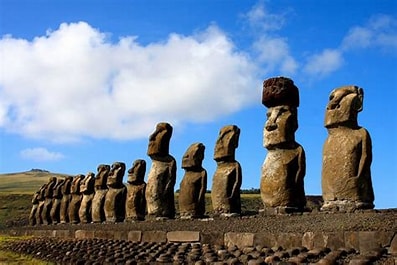
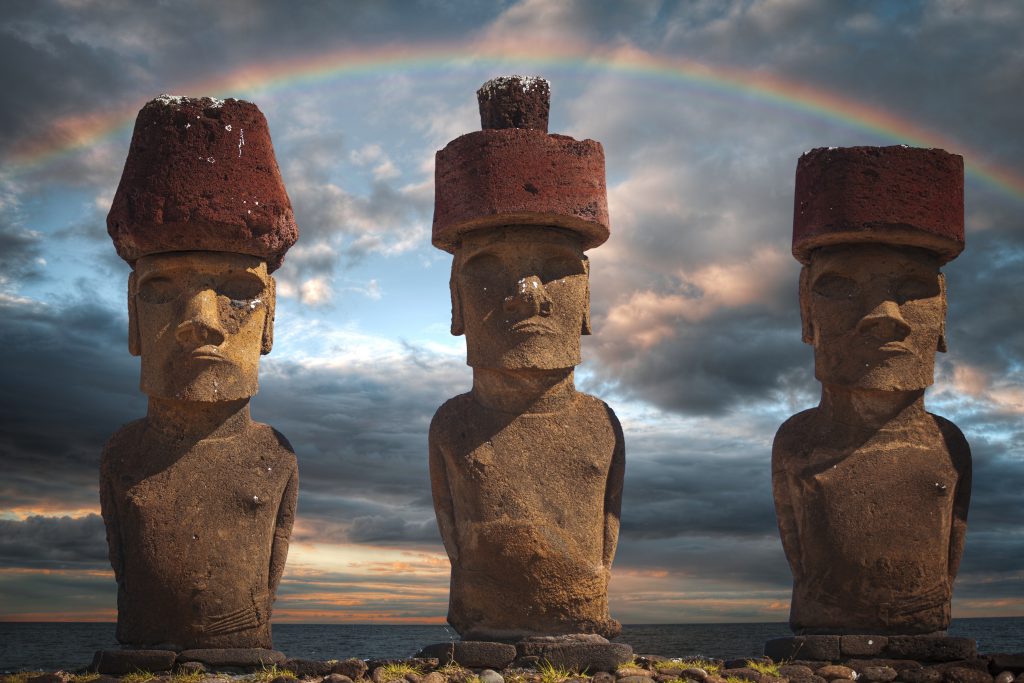
The investigators in the movie (2017) point to three possible locations for Atlantis, namely 1) between Italy and Sicily, 2) the south of Spain and also 3) in the Azores. Interesting. It is certainly worth the time to watch the whole video. But I think what they found could possibly be just the remnants of ancient colonies (of the Atlanteans??). Truth be told, they can be found everywhere on Earth. In fact, if you go up the main Giza pyramid to the Kings Chamber, you will find granite blocks in the stairway so big that you cannot figure out how people who barely invented the wheel, could have put them there. Easter Islanders carved and moved the largests stone sculptures ever created. Let us just take a look at the giants of Easter Island:

It appears the inhabitants of Easter Island managed to create a complex and prosperous society and peopled their island with a race of stone giants so big and so heavy that even modern engineers marvel at it.  One wonders how the islanders could have built and moved the colossal statues weighing up to 80 tons.  The biggest mystery is: why?  The fact that they are all male figures lets me think that this is a type of fore-father worship, like we have it here in many cultures in Africa.  According to the islanders’ own legend, a big Chief called Hotu Matua was forced to leave his native Marae Renga in the archipelago of Hiva due to a natural disaster when all the land of Hiva disappeared beneath the sea. All the accounts agree that Marae Renga was situated towards the setting sun and the climate there was hot. The chief and his entourage brought with them all kinds of plants, trees and animals….* (The World’s Last Mysteries, page 99). 

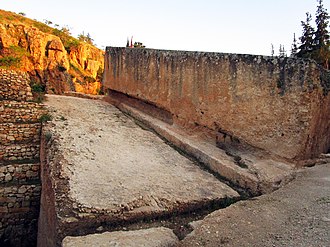
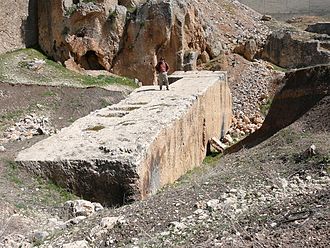
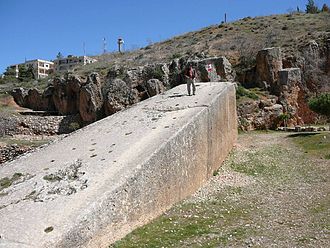
But what about Ba’albek? (44 miles east of Beirut). This acropolis with its ruins and gigantic temples is one of the most imposing sites of the world:

Clearly, the Roman sanctuaries of Jupiter and Venus succeeded earlier temples dedicated to the corresponding Semitic divinities Ba’al and his partner, the Goddess Astarte. Apparently, this religion included prostitution and sacred orgies. The Roman architectural structures – which were largely destroyed by an earthquake in 1759 – do not pose any archaeological problems. On the other hand, one part of the enclosure wall, called the Trilithon, is composed of three blocks of hewn stone each weighing 750 tons. It is an amazing piece of building, as the blocks have been raised almost 7 meters in order to lie on top of smaller blocks. Another hewn block, 4 x 4 meter and 21 meters long, weighing at least 1000 tons, the largest hewn stone known to man, lies in the quarry. Did the Romans build the trilithon or does it date back to an earlier period, and if so, how were these colossal blocks of stone raised into position? Large numbers of pilgrims came from Mesopotamia as well as the Nile valley to the temple of Ba’al-Astarte. It is mentioned in the Bible, namely Joshua 12:7. Of course we also remember the story of King Achab who married a Phoenician wife  and subsequently they introduced the Ba’al worship in Israel. Ancient Arab writings tell us that the first temples of Ba’al – Astarte were built there a short time after the Flood, at the order of the legendary King Nimrod, by a ‘tribe of giants’ (The World’s Last Mysteries, page 308)

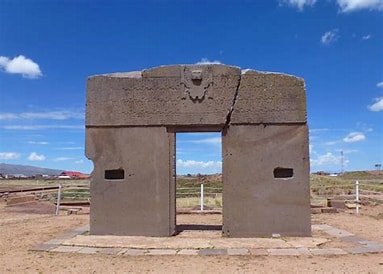
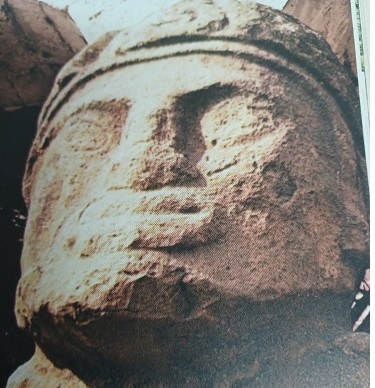
On the other side of the world, on a bleak plateau, nearly 4000 meters high up in the Andes, are the remnants of a brilliant and long-forgotten civilization: the City of Tiahuanaco. Apparently once you have seen it, it is easy to believe in the Indian legend that the city was originally built by a race of giants. Investigations showed that the stone used in the buildings came from quarries between 60 and 200 miles away from the city. Consequently, the experts have had to face the question of how it was possible that blocks of stone weighing up to 100 tons each – some even more – were transported over ground. Remnants of the roads that must have been used for this were also found. Yet even so, the best engineers look at all of this in amazement. The giant blocks look almost as though a die were used to cut them. Even trying to make this with modern technology available today would present some challenges, not to mention the movement of such objects over such long distances. A big puzzle. The Indians say that the stone face with beard (see above), standing at the entrance of the church porch in modern Tiahuanaco – a village built from stones torn from the temples and palaces of Tiahuanaco – depicts Viracocha, the legendary god who arose from the sacred lake of Titicaca. The story goes that this bearded white god created the Andean world. He is said to have appeared in Tiahuanaco after a flood which lasted 60 nights and engulfed big cities in its path. Note that the original Indians were almost beardless (The World’s Last Mysteries, page 134) 

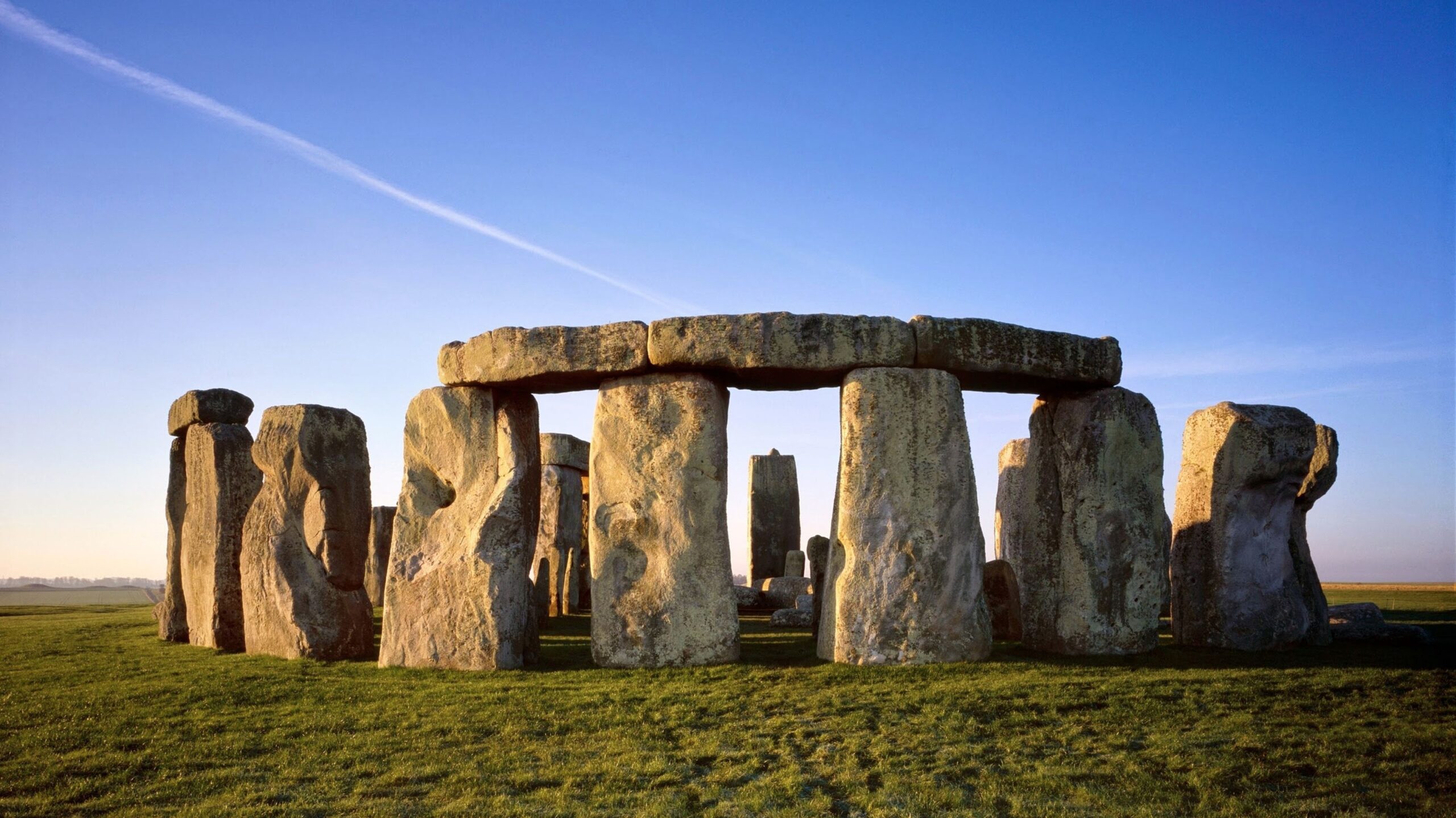
Finally, let us once again look at Stonehenge. It seems likely that building of the monument could have started more than 5000 years ago:

Archaeologists have known for a while that the bluestones used to make Stonehenge originated from quarries in Pembrokeshire, Wales, 150 miles away, but how the stones arrived at their current spot is less clear. According to one theory, humans spent months transporting the materials, possibly with wooden sleighs on rollers, oxen, or river rafts. Other experts insist that it would have been impossible to transport the 25-ton rocks such a great distance using primitive technology. Instead, they say the stones were placed there by glacial activity. The new study published in the journal Antiquity debunks that idea. Archaeologists and geologists from the UK studied the smaller rocks used to build Stonehenge and pegged them to two quarries in the Preseli Hills of Wales. Upon visiting the sites, they discovered traces of tools, stone wedges, and digging activity. The evidence dates back to 3000 BCE, the same time when construction on Stonehenge started. The research team says their findings suggest that materials used to make Stonehenge were moved by purposeful human activity rather than freak natural forces. But the study still leaves some questions unanswered, such as how the ancient peoples were able to transport the rocks 150 miles after digging them up. The fact that the rocks came from the north side of the Preseli Hills suggests they were dragged over land rather than transported by river—though the exact methods used remain a mystery.

Source: Scientists Solve an Ancient Stonehenge Mystery: Where the Massive Rocks Came From | Mental Floss

SUMMARY

The question now is: who were these people that set up these giant structures, like the Tower of Babel, as if they wanted to reach heaven and ‘make a name for themselves’ (Gen. 11: 4). That actually brings us again back to the question: who were the ‘Sons of God’ mentioned in Gen. 6:2? It seems obvious to me that if Jesus calls Himself “Son of Man”, that the ‘Sons of God’ mentioned in Gen. 6:2 must have been descendants from Adam, who was God’s first child. It seems likely that they must therefore have been the off-spring of Seth and Cain.

Now click on the link below and please carry on reading here:

Could it be that an advanced civilization of giant people existed long before Noah’s flood? | Bread on the water